TL;DR: FEMA approved Public Assistance for 34 Missouri counties for June 4-18 storms, while a July 9-11 request for nine other counties was still pending on Aug. 2.
WASHINGTON — A FEMA Alert dated Aug. 3, 2026, which falls within the Aug. 2 news day in Eastern Time, states that FEMA has issued a Major Disaster Declaration for Missouri to supplement state, tribal and local recovery efforts in areas affected by severe storms, straight-line winds, tornadoes, and flooding from June 4-18, 2026, according to the Safeguard Properties FEMA Alert titled “FEMA Major Disaster Declaration - Missouri Severe Storms, Straight-line Winds, Tornadoes, and Flooding.”
The declaration, identified in that alert as Missouri Severe Storms, Straight-line Winds, Tornadoes, and Flooding (DR-4929-MO), approves Public Assistance for 34 counties, according to that same Safeguard Properties FEMA Alert.
A separate request for catastrophic flash flooding and severe storms July 9-11 covering nine counties in south-central and southeastern Missouri had not been approved as of Aug. 2, when members of Missouri’s congressional delegation publicly urged President Donald J. Trump to approve it, according to the Aug. 2 report titled “Smith, Missouri Delegation Urge OK Of Disaster Declaration.”
What was approved for the June 4-18 storm period
The Safeguard Properties FEMA Alert states the incident period for the approved declaration is June 4-18, 2026.
The alert states the purpose is to supplement state, tribal and local recovery efforts in areas affected by severe storms, straight-line winds, tornadoes, and flooding.
The alert lists the declaration number as DR-4929-MO.
According to the Office of Governor Mike Kehoe in a July 29, 2026, announcement titled “Governor Kehoe Requests Federal Disaster Declaration in Response to Catastrophic Flash Flooding and Severe Storms July 9-11,” the June 4-18 storms request was described on July 29 as pending for FEMA Public Assistance.
That July 29 announcement from the Governor’s office also states that the April 23-28 storms request had been approved for FEMA Public Assistance.
The Aug. 2 delegation report states Missouri already has a declaration for storms that occurred April 23-28, and is seeking its third disaster declaration of 2026 for the July storms, according to that report titled “Smith, Missouri Delegation Urge OK Of Disaster Declaration.”
Which 34 counties are covered for Public Assistance
The Safeguard Properties FEMA Alert lists Public Assistance approval for Adair, Andrew, Callaway, Camden, Cape Girardeau, Dade, Daviess, Gasconade, Gentry, Grundy, Harrison, Hickory, Holt, Jasper, Knox, Lewis, Linn, Macon, Marion, Mercer, Miller, Moniteau, Morgan, Newton, Nodaway, Osage, Polk, Putnam, Scott, Shelby, Sullivan, Vernon, Webster and Worth.
Households in those counties should understand the distinction stated in federal and state materials: Public Assistance in this action is directed to public recovery, not direct payments to residents.
According to the July 29 announcement from the Office of Governor Mike Kehoe, the FEMA Public Assistance program described for Missouri’s 2026 storm requests would make assistance available to local governments and qualifying nonprofits for repair and rebuilding of damaged roads, bridges, and other public infrastructure as well as reimbursement of emergency response costs and debris removal.
Residents who need help with repairs to private property, temporary housing or other personal needs are not covered by a Public Assistance-only approval.
According to that same July 29 Governor’s office announcement, Missourians still experiencing unmet needs are encouraged to contact United Way at 2-1-1 or the American Red Cross at 1-800-733-2767, and to visit recovery.mo.gov for additional resources and information about disaster recovery in Missouri, including general clean-up information, housing assistance, and mental health services.
Why the June and July events are different requests
The approved DR-4929-MO incident period is June 4-18, 2026, according to the Safeguard Properties FEMA Alert.
The pending request described on Aug. 2 covers July 9-11, according to the Aug. 2 report titled “Smith, Missouri Delegation Urge OK Of Disaster Declaration.”
According to the July 29 announcement from the Office of Governor Mike Kehoe, the July 9-11 request seeks federal assistance for nine counties: Bollinger, Crawford, Iron, Madison, Morgan, Reynolds, Ripley, Washington, and Wayne counties.
Morgan County appears in both the 34-county June approval list and the nine-county July request list, according to comparison of the Safeguard Properties FEMA Alert and the Governor’s July 29 announcement.
According to the Governor’s July 29 announcement, joint preliminary damage assessments conducted by the Federal Emergency Management Agency (FEMA), the State Emergency Management Agency (SEMA), and local officials estimated more than $26.5 million in emergency response costs and damage to public infrastructure in those nine counties because of the July 9-11 storm system.
The Aug. 2 delegation report similarly states that joint preliminary damage assessments identified more than $26.5 million in eligible infrastructure damage and emergency protective costs across nine counties following the July storms.
What officials reported about the July 9-11 flooding
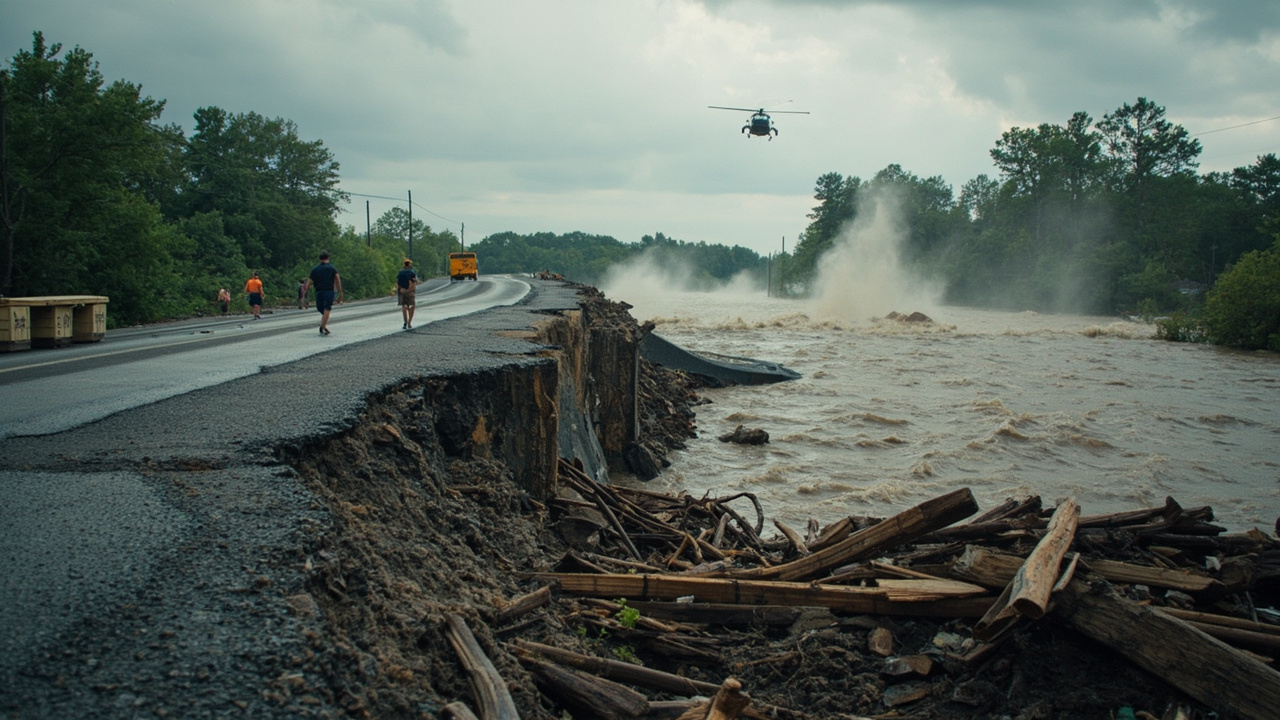
In a letter to the president described in the Aug. 2 report, lawmakers said a series of slow-moving thunderstorms produced torrential rainfall across portions of south-central and southeastern Missouri, according to that report titled “Smith, Missouri Delegation Urge OK Of Disaster Declaration.”
Some areas received an estimated 6 to 12 inches of rain in about 12 hours, according to that same Aug. 2 report.
The National Weather Service described rainfall in some locations as equivalent to a 1-in-1,000-year event, according to that Aug. 2 report.
Rivers, creeks and low-lying areas rose rapidly, including the Black River near Annapolis, which reached a record crest, according to that Aug. 2 report.
The lawmakers wrote that first responders rescued over 350 people, including over 200 airlifted from Camp Taum Sauk by Missouri National Guard helicopters, according to that Aug. 2 report.
A July 31, 2026, announcement from Senator Eric Schmitt’s office titled “Schmitt Leads Missouri Lawmakers in Letter Supporting Governor’s Disaster Declaration Request Following Devastating Floods” states the letter supports Governor Mike Kehoe’s July 28, 2026, request for a major disaster declaration for storms July 9 through July 11.
That July 31 Senator Schmitt announcement states floodwaters overwhelmed campgrounds and farms, washed out critical access routes, and forced emergency crews to evacuate families and children.
Damage scale cited for the July request
According to the July 29 announcement from the Office of Governor Mike Kehoe, the estimated damage in Iron County alone surpassed $19.7 million, while the entire state threshold to qualify for federal disaster assistance is $11.9 million.
Governor Mike Kehoe said the damage has overwhelmed local communities, placing a burden that far exceeds their capacity to recover without federal assistance, according to that July 29 Governor’s office announcement.
The Aug. 2 report states the letter noted Missouri received five federal disaster declarations in 2025, more than any other state.
That July 31 Senator Schmitt announcement similarly states that in 2025 alone, Missouri received five federally declared disasters — the most of any state — and that many communities affected by the July storms were still recovering from previous disasters.
What the delegation asked for on Aug. 2
According to the Aug. 2 report titled “Smith, Missouri Delegation Urge OK Of Disaster Declaration,” Congressman Jason Smith and other members of Missouri’s congressional delegation asked President Donald Trump to approve Gov. Mike Kehoe’s request for a major disaster declaration following flooding July 9-11.
The lawmakers wrote: “We respectfully urge you to direct your administration to promptly review Governor Kehoe’s major disaster declaration request for the July 9 through July 11 storms and submit it for your approval,” according to that Aug. 2 report.
According to that Aug. 2 report, the letter was also signed by U.S. Sens. Josh Hawley and Eric Schmitt and U.S. Rep. Ann Wagner.
According to the July 31 Senator Schmitt announcement, Senator Josh Hawley, Congressman Jason Smith and Congresswoman Ann Wagner joined Senator Schmitt in sending the letter.
Smith recently toured flood damage in Reynolds County, including Valley Springs Youth Ranch and Black River Baptist Church, two locations heavily damaged by the storms, according to the Aug. 2 report.
“The pictures don’t do justice to the damage,” Smith said, according to that Aug. 2 report.
Smith said families lost homes, farmers lost equipment and livelihoods, and a church that serves more than 100 families through food distributions had its sanctuary destroyed, according to that Aug. 2 report.
Household readiness steps while aid moves through government channels
On July 24 and 25, a total of 144 families with 232 adults and 39 children connected to services and supplies provided by volunteers, faith-based partners and state and local agencies at a Multi-Agency Resource Center held in Centerville, according to the July 29 announcement from the Office of Governor Mike Kehoe.
For households in either the approved June counties or the nine counties in the pending July request, the state’s listed contact points remain United Way at 2-1-1, the American Red Cross at 1-800-733-2767, and recovery.mo.gov, according to that July 29 Governor’s office announcement.
Residents should keep county, incident-period and program details together when calling, because the June approval and July request involve different dates and different county lists.
Local governments and qualifying nonprofits seeking Public Assistance reimbursement should track emergency response costs, debris removal, and damage to roads, bridges and other public infrastructure, the categories named in the Governor’s July 29 announcement.
Households should not wait for a federal decision to document private damage, clean up safely, and seek local and nonprofit help through the contacts above.