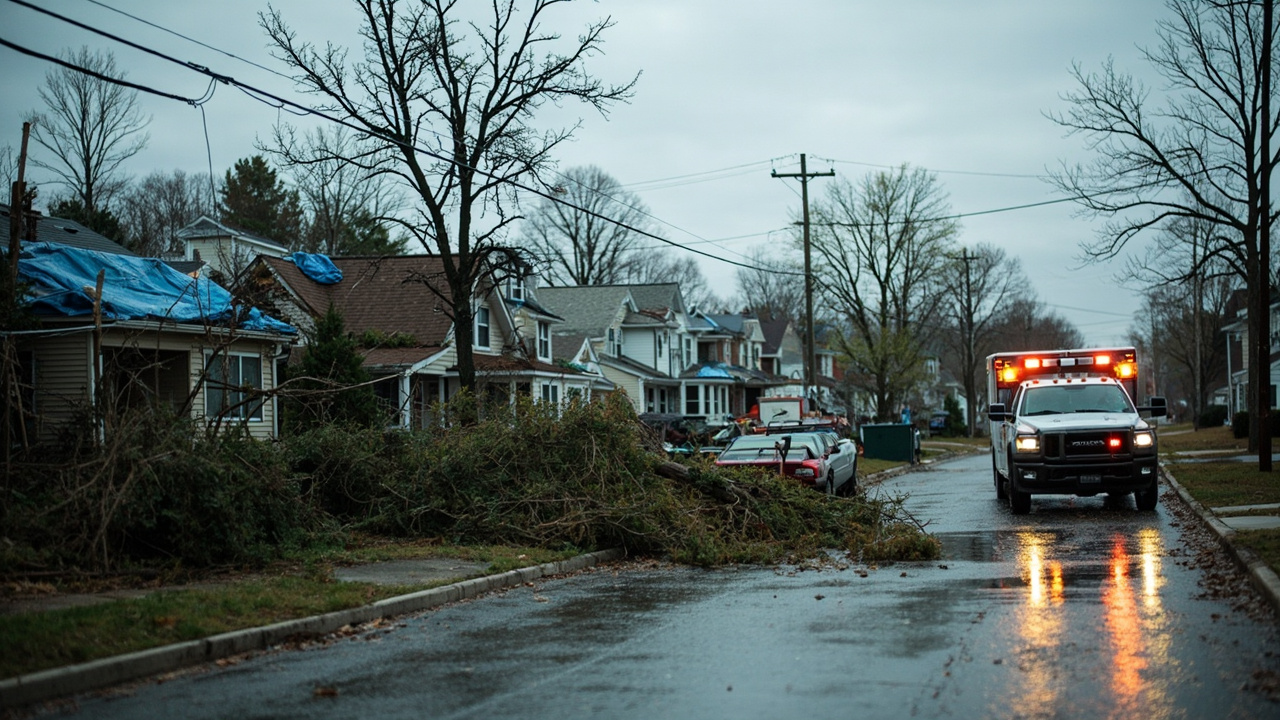
TL;DR: Households in 21 Indiana counties can now seek federal help for damage from severe storms, straight-line winds, tornadoes and flooding that began Aug. 11, 2026, after federal disaster assistance was made available to supplement state recovery efforts.
Federal action unlocks help for households
Federal disaster assistance is available to the state of Indiana to supplement recovery efforts in areas affected by severe storms, straight-line winds, tornadoes and flooding from Aug. 11, 2026, and continuing, according to FEMA in its release titled "President Donald J. Trump Approves Major Disaster Declaration for Indiana."
The announcement, carried in local reporting by WBIW in "President Donald Trump approves Major Disaster Declaration for Indiana," states that the President's action makes federal funding available to affected individuals in designated counties.
Assistance can include grants for temporary housing and home repairs, low-cost loans to cover uninsured property losses and other programs to help individuals and families recover from the effects of the disaster, according to FEMA.
For household planning, the key distinction is timing. The incident period began Aug. 11, 2026, and was described as continuing at the time of the announcement. That means residents should document damage tied to that storm period, keep insurance paperwork together, and track additional expenses tied to housing and repairs.
Darrin C. Ricketts has been named the Federal Coordinating Officer for federal recovery operations in the affected areas, according to FEMA. WBIW also reported that additional designations may be made at a later date if warranted by the results of damage assessments, so households in nearby counties should continue to monitor official updates.
Which 21 counties qualify for individual help
The President's action makes federal funding available to affected individuals in Carroll, Dearborn, Decatur, Delaware, Fayette, Franklin, Hamilton, Hancock, Henry, Lake, LaPorte, Madison, Marion, Morgan, Porter, Pulaski, Randolph, Rush, Tipton, Union and Wayne counties, according to FEMA.
WBIW listed the same 21 counties for individual assistance, describing the categories as temporary housing, home repairs and other recovery programs for individuals and families.
The breadth matters for preparedness. The list spans northwest Indiana lakefront counties such as Lake, LaPorte and Porter, central counties including Marion, Hamilton, Hancock, Madison and Morgan, eastern counties including Delaware, Henry, Randolph, Wayne, Fayette and Union, southeastern counties including Dearborn, Decatur, Franklin and Rush, and northern and west-central counties including Carroll, Pulaski and Tipton.
WFYI Public Media reported in "President Trump approved a 'major disaster declaration' for 21 Indiana counties. What does that mean?" that Gov. Mike Braun had requested assistance for 54 counties after severe storms flooded homes and left thousands without power, and that FEMA approved 21 counties in this action.
State officials noted that counties not currently listed may still become eligible pending additional review and data collection, according to reporting by WFIE carried in related coverage of the governor's announcement. Households outside the current list should not discard damage records, photos, receipts or insurance letters.
How households should apply
Individuals and families who sustained losses in the designated areas should first file claims with their insurance providers and then apply for assistance online at www.DisasterAssistance.gov, by calling 1-800-621-3362 or by using the FEMA App, according to FEMA.
The same application sequence was reported by WBIW: file with insurance first, then seek federal assistance through the website, phone line or mobile app.
If you use a relay service, such as video relay service, captioned telephone service or others, provide FEMA with the number for that service, according to FEMA. That detail is important for households where a member relies on relay calling to communicate with agencies.
Preparedness experts routinely advise keeping one folder — paper or digital — for each adult in the home. For this event, that folder should include the insurance claim number, date the claim was filed, photos of damage before cleanup, contractor estimates, hotel receipts if displaced, and any letters from the insurer explaining what is covered and what is not.
Residents may qualify for help with temporary housing, home repairs and uninsured property losses, according to local reporting on the declaration. The federal notice describes those supports as grants for temporary housing and home repairs, low-cost loans to cover uninsured property losses, and other programs for individuals and families.
Households should treat grants and loans as separate tracks. Read each award letter carefully, note deadlines for appeals or added documentation, and avoid signing repair contracts that promise federal reimbursement without written confirmation of eligibility.
Public assistance covers 11 counties
Federal funding is also available to state, tribal and eligible local governments and certain private nonprofit organizations on a cost-sharing basis for emergency work and the repair or replacement of facilities damaged by the storms, winds, tornadoes and flooding, according to FEMA.
The 11 counties named for that category are Delaware, Fayette, Franklin, Hamilton, Henry, Lake, LaPorte, Madison, Porter, Tipton and Wayne counties.
WBIW described the same group as public-assistance counties and identified the purpose as emergency work and repair or replacement of damaged facilities.
For households, public assistance does not pay individual claims directly. It matters because it supports reopening of roads, public buildings, utilities and other shared systems that families rely on after floods and wind damage. When local facilities are repaired faster, school routines, commutes and access to clinics and grocery stores stabilize sooner.
Additional designations may be made at a later date if warranted by damage assessments, according to FEMA. That leaves open the possibility that more counties or categories could be added as state and federal teams complete reviews.
State request, timeline and joint briefings
Indiana Gov. Mike Braun announced that President Trump approved a major disaster declaration through the Federal Emergency Management Agency, according to WBIW in "Governor Braun secures major disaster disaster relief from President Trump, FEMA."
Braun said he formally requested an expedited major disaster declaration on Aug. 20, according to that WBIW report. The governor's office said the expedited approval means millions of federal dollars will now be available to assist recovery efforts in Hoosier communities.
In a statement quoted by WBIW, Braun said: "I am pleased to share that my request for a major disaster declaration has been approved for multiple counties."
The governor added thanks for federal partnership and said the support would help residents recover from historic storms and flooding and help communities rebuild and get back on their feet, as quoted by WBIW.
The Indiana Department of Homeland Security and FEMA were expected to provide joint briefing materials and next steps on Wednesday, Aug. 26, according to WBIW. Households should look for those state-federal updates before traveling to assistance centers, because hours, locations and documents required can change during the first week of operations.
What Indiana 211 and state funds add
Beyond FEMA, Indiana maintains referral and gap-aid options that households can use while federal applications are pending.
WBIW reported on Aug. 27 that through Indiana 211, residents can text IN211HELP to 898-211 to get started finding disaster recovery resources. The report described the service as operating around the clock, prompting users to select the type of assistance needed and providing disaster-specific resources based on the entered ZIP code.
That text option complements the Indiana 211 website and call line by dialing 2-1-1, which state officials have described as a central point for food, housing, disaster relief and other community resources during response and recovery.
Separately, WLWT reported in "President Trump approves major disaster declaration for Indiana after storms" that Indiana's State Disaster Relief Fund will provide up to $5,000 in emergency aid grants to Hoosiers in need of assistance. Households facing immediate costs for cleanup, temporary lodging or essential repairs should ask state briefers whether that fund applies in their county and what documentation is required.
WLWT also reported that members of FEMA and the Indiana Department of Homeland Security were conducting damage assessments in impacted counties, and that Indiana public-safety agencies including the Indiana National Guard, Indiana State Police, Department of Correction and Department of Natural Resources were deployed on emergency response missions, according to Gov. Braun.
Household readiness checklist for the next two weeks
Use the declaration as a prompt to reset basic readiness, even if your home had limited damage.
First, complete the insurance-then-FEMA sequence without delay if you are in one of the 21 individual-assistance counties. File the insurer claim, save the claim number, then apply at DisasterAssistance.gov, through the FEMA App or at 1-800-621-3362, as directed by FEMA.
Second, photograph every damaged room, appliance, furnace, electrical panel and vehicle before disposal. Keep samples of flooring or drywall if an adjuster asks for proof of water height. Store images in cloud backup in case a phone is lost.
Third, separate storm trash from valuables. Do not discard insurance or FEMA letters. Keep utility shutoff notices, medical device power needs and prescription lists in the same folder so any caseworker can see health-related priorities quickly.
Fourth, plan for power interruptions that often follow wind and flood events. Charge battery banks, keep fuel for generators outside living spaces, test flashlights and weather radios, and confirm a contact outside the affected area who can relay messages if local networks are congested.
Finally, recheck county eligibility each week. Because additional designations may follow damage assessments, a county excluded this week could be added later. Rely on FEMA releases and Indiana Department of Homeland Security briefings rather than social-media summaries when deciding whether to apply.
Sources referenced
- President Donald J. Trump Approves Major Disaster Declaration for Indiana | FEMA.gov (https://www.fema.gov/press-release/20260826/president-donald-j-trump-approves-major-disaster-declaration-indiana)
- President Donald Trump approves Major Disaster Declaration for Indiana | WBIW (https://www.wbiw.com/2026/08/27/president-donald-trump-approves-major-disaster-declaration-for-indiana/)