TL;DR: Three river Flood Warnings were in force in Florida and Georgia on Oct. 16, 2026, while federal emergency declarations backed Hurricane Isaias response in Alabama, Florida and Georgia after an Oct. 9 Category 2 landfall.
Newest verified river flooding
The National Weather Service had three Flood Warnings in force for rivers in Florida and Georgia on Friday, Oct. 16, 2026, according to the ALLATRA Media report citing National Weather Service offices.
All three rivers had risen to or above flood stage, the agency said, as cited in that report.
The warnings extend a flood-warning episode that has covered rivers across Georgia, South Carolina and Florida, with an earlier stage of the same episode covering five Flood Warnings across the three states as of Oct. 14, 2026.
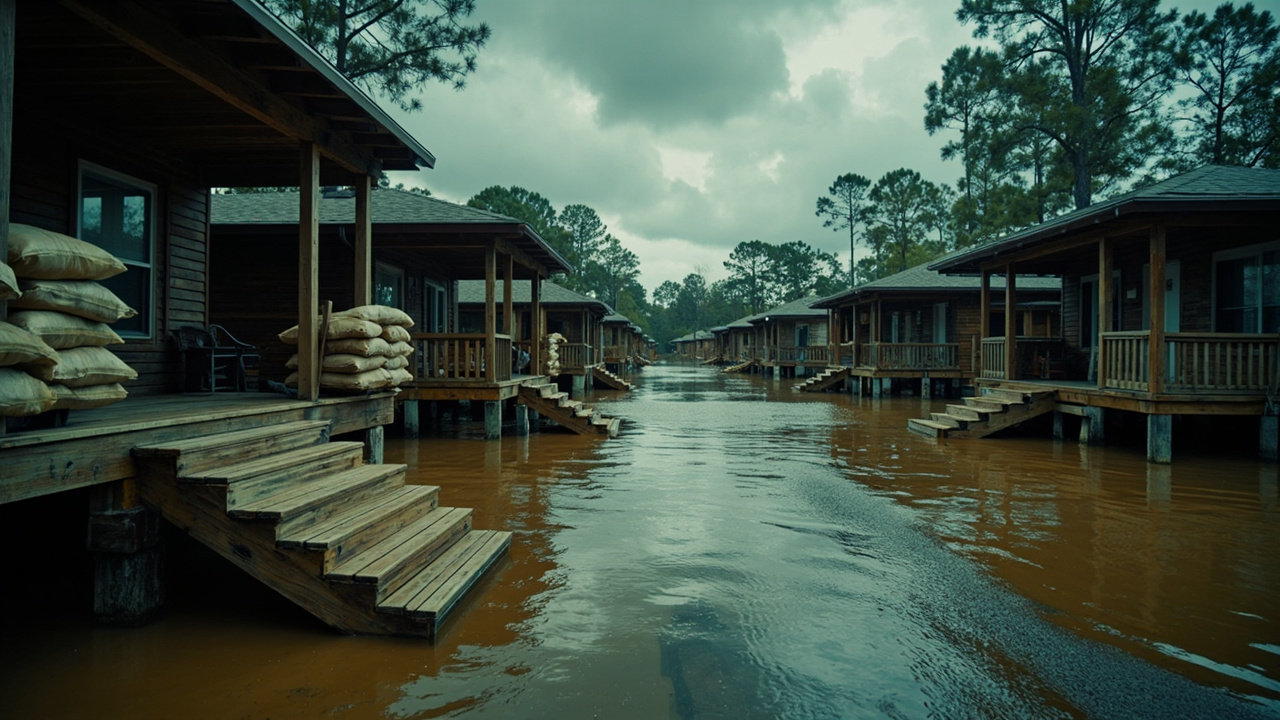
In Sarasota County, Florida, the agency's Tampa Bay Ruskin office said the Myakka River at Myakka River State Park stood at 7.1 feet at 10 a.m. EDT, just above its 7.0-foot bankfull stage.
Water approached the porch steps of cabins at the park, and the Park Nature Trail flooded.
The warning for the Myakka River runs until 2 a.m. EDT Oct. 18, 2026.
In Lake and Volusia counties, the agency's Melbourne office said the St. Johns River near Astor was forecast to produce moderate flooding.
The river stood at 2.6 feet at 9:30 a.m. EDT, against a 2.0-foot bankfull stage.
In Brantley County, Georgia, the agency's Jacksonville office said the Satilla River at Atkinson had reached 13.5 feet at 9:45 a.m. EDT.
At 13.0 feet, the river floods secondary roads and low-lying areas near Atkinson.
Residents and visitors should continue to follow guidance from local officials and monitor local weather, according to the FEMA Bulletin Week of October 14, 2026.
State and local officials continue leading lifeline stabilization and recovery efforts, while FEMA and other federal partners continue to align resources with state needs, that bulletin states.
For state updates, that bulletin directs residents to the Florida Division of Emergency Management, the Alabama Emergency Management Agency, and the Georgia Emergency Management and Homeland Security Agency.
Hurricane Isaias landfall and emergency declarations
Hurricane Isaias made landfall as a Category 2 hurricane on Oct. 9, according to the FEMA Bulletin Week of October 14, 2026.
A FEMA Daily Operations Briefing for Oct. 10, 2026 places landfall in the Florida Panhandle at 9:30 p.m. ET on Oct. 9 and describes the system as downgraded afterward to a post-tropical cyclone.
In response to Hurricane Isaias, President Donald J. Trump approved emergency declarations for Alabama, Florida and Georgia to support state-led, locally executed response and recovery efforts, that FEMA bulletin reports.
The President's action authorized FEMA to coordinate all federal disaster relief efforts to provide federal assistance to save lives, protect property, public health and safety and to reduce or prevent further impacts from the storm.
Federal emergency declarations allow states to tap into federal support through FEMA to provide lifesaving, life-sustaining resources, including restoring power, clearing roads for emergency services and keeping communities safe.
Under the emergency declarations, FEMA Public Assistance is available at a 75% federal cost share for eligible emergency protective measures in the three states.
FEMA activated coordination capabilities and positioned personnel and resources to support state requests before, during and after the storm.
FEMA staff were embedded with state emergency operations centers across the Southeast.
Urban Search and Rescue teams were staged throughout the region ahead of potential impacts, and those teams have completed their missions, the bulletin states.
Incident Management Assistance Teams were deployed to Alabama, Georgia and Florida to enhance coordination on site, facilitating any state requests for federal support.
Mobile Emergency Response Support assets were deployed to Florida and Alabama, providing mobile communications, logistics and operations capabilities for responders.
The agency coordinated with state, local, tribal, voluntary and other federal partners to support lifesaving and life-sustaining operations.
Staged commodities and equipment, including water, meals, tarps, blankets, cots and generators, were positioned to support state requests.
State and local officials are assessing damages across impacted regions with FEMA on the ground to support, and these assessments will help the state determine whether the extent of damages warrants a request for federal assistance.
Last week, President Donald J. Trump approved nine major disaster declarations that make recovery assistance available to seven states, one territory and one tribal nation, the same bulletin reports.
Evacuations, shelters and power impacts
Mandatory and voluntary evacuations were in effect for multiple Alabama coast and Florida Panhandle counties covering 152,000 people, according to the FEMA Daily Operations Briefing for Oct. 10, 2026.
State search-and-rescue teams were prepositioning with mutual-aid support identified, while federal teams were being staged pending state requests for support.
The American Red Cross count cited in that briefing listed 5 shelters with 222 occupants in Alabama, 11 shelters with 853 occupants in Florida, and 5 shelters with 90 occupants in Mississippi as of 6:50 a.m. ET Oct. 10.
Florida reported pre-landfall evacuations at five healthcare facilities, including one hospital, in Walton and Okaloosa Counties.
FEMA Region 4 had 879,000 customers without power, representing 3% of customers region-wide, as of 7:30 a.m. ET Oct. 10, according to Department of Energy Eagle-I data cited in the briefing.
The same power snapshot listed Alabama with 290,000 customers without power, or 13% statewide, Florida with 458,000 customers without power, or 4% statewide, Georgia with 126,000 customers without power, or 3% statewide, and Mississippi with 608 customers without power, or less than 1% statewide.
Many airports and seaports were at restricted operating status, with Gulfport, Pascagoula, Mobile, Pensacola, Destin, Panama City and Port St. Joe closed.
Destin-Fort Walton Beach and Pensacola International, Mobile Regional and Gulf Shores International airports were closed.
Florida's State Emergency Operations Center was at Full Activation for Tropical Cyclone Isaias with an approved Emergency Declaration FEMA-3655-EM-FL, Alabama's center was at Full Activation with Emergency Declaration FEMA-3656-EM-AL, Georgia's center was at Full Activation with a governor-requested Emergency Declaration, and Mississippi's center was Monitoring, according to that briefing.
Call 211 or visit a local emergency management agency or community website for the location of shelters, according to the FEMA Bulletin Week of October 14, 2026.
Residents can also find shelters by visiting the American Red Cross shelter locator or calling 800-RED-CROSS.
Why flood risk demands household planning
Flooding is the most common disaster in the United States, according to the Ready.gov Floods page.
Flooding is a temporary overflow of water on normally dry land, that page states.
Floods may result from rain, snow, coastal storms, storm surges and overflows of dams and other water systems.
Floods may develop slowly or quickly, and flash floods can come without warning.
Floods may cause outages, disrupt transportation, damage buildings and create landslides.
Nearly every day, flooding happens somewhere in the United States or its territories, according to the National Weather Service Flood Safety and Preparedness page.
Flooding can cause more damage in the United States than any other weather-related event, with an average of 8 billion dollars a year, that page states.
Flooding causes nearly 90 fatalities per year in the United States, that page states.
In September 2024, Georgia experienced widespread wind damage and flooding from Hurricane Helene, with heavy rainfall contributing to extreme runoff and flash flooding, including nearly 100 river gauges that observed flooding conditions, according to the National Weather Service 2026 Flood Safety Preparedness Week page for Georgia.
Fifteen river gauges set new records due to Helene's inland flooding, and all of the gauges that experienced Moderate or Major river flooding were in the highly populated metro Atlanta area, that page states.
Before a flood: household readiness checklist
Know your risk for floods and visit FEMA's Flood Map Service Center to know types of flood risk in your area, according to the Ready.gov Floods page.
Flooding does not follow lines on a map, that page cautions.
Check whether you live in a floodplain and verify whether dam or levee systems are in your area, according to the National Weather Service Flood Safety and Preparedness page.
FEMA operates an online map service center to help residents check floodplain status, and the U.S. Army Corps of Engineers has information about dams and levees.
Homeowner's insurance policies do not cover flooding, according to the Ready.gov Floods page.
Purchase flood insurance or renew a flood insurance policy well before a disaster because it typically takes up to 30 days for a policy to go into effect, with coverage available under the National Flood Insurance Program.
Standard homeowners insurance does NOT cover flooding, and flood insurance requires a 30-day waiting period, according to the National Weather Service Flood Safety and Preparedness page.
Find coverage at floodsmart.gov, that page states.
Make a plan for your household, including pets, so everyone knows what to do, where to go and what will be needed for protection from flooding, according to the Ready.gov Floods page.
Prepare a family disaster plan that includes a communications plan and list of contacts, according to the National Weather Service Flood Safety and Preparedness page.
Learn and practice evacuation routes, shelter plans and flash flood response.
Plan and practice a flood evacuation route with family and ask an out-of-state relative or friend to be the family contact in case the family is separated during a flood, according to National Weather Service flood-watch safety guidance.
Make sure everyone in the family knows the name, address and phone number of that contact person.
Gather supplies, including non-perishable foods, cleaning supplies and water for several days, in case departure must be immediate or services are cut off in the area.
Assemble a disaster supplies kit and find out where to go if ordered to evacuate.
Make a keep-in-touch arrangement with relatives and friends.
Make an itemized list of personal property well in advance, and photograph or video the interior and exterior of the home.
Keep insurance, important documents and other valuable items in a safe deposit box.
Keep documents in a waterproof container in case of emergency and create password-protected digital copies, according to the Ready.gov Floods page.
Move valuables to higher levels, declutter drains and gutters, install check valves, and consider a sump pump with a battery.
Sign up for the community warning system, noting that the Emergency Alert System and NOAA Weather Radio also provide emergency alerts.
When flooding is expected, keep informed through National Weather Service websites, mobile weather sites, NOAA All Hazards Radio and Wireless Emergency Alerts for Flash Flood Warnings available on most smartphones.
If forced to leave property and time permits, move essential items to safe ground, fill tanks to keep them from floating away and grease immovable machinery, according to the National Weather Service Flood Safety and Preparedness page.
Store a supply of drinking water in clean bathtubs and in large containers.
Get out of areas subject to flooding, including dips, low spots and floodplains.
During a flood: protective actions
Find safe shelter right away if under a flood warning, according to the Ready.gov Floods page.
Do not walk, swim or drive through flood waters, and remember the warning: Turn Around, Don't Drown.
Just six inches of moving water can knock a person down, and one foot of moving water can sweep a vehicle away, that page states.
Even six inches of fast-moving floodwater can knock a person off their feet, and a depth of two feet will float a car, according to the National Weather Service Flood Safety and Preparedness page.
Never try to walk, swim or drive through such swift water.
Do not attempt to drive over a flooded road, but stop, turn around and go another way.
Never drive around barricades because local responders use them to safely direct traffic out of flooded areas, according to the Ready.gov Floods page.
Stay off bridges over fast-moving water because fast-moving water can wash bridges away without warning.
Stay inside the car if it is trapped in rapidly moving water, and get on the roof if water is rising inside the car.
Get to higher ground immediately if living in a flood-prone area or camping in a low-lying area, according to the National Weather Service Flood Safety and Preparedness page.
Get to the highest level if trapped in a building, and only get on the roof if necessary and once there signal for help, according to the Ready.gov Floods page.
Do not climb into a closed attic to avoid getting trapped by rising floodwater.
Obey evacuation orders and, if told to evacuate, do so immediately, locking the home when leaving and, if there is time, disconnecting utilities and appliances.
Evacuate immediately if told to do so, and depending on the type of flooding, move to higher ground or a higher floor or stay where directed.
Avoid areas subject to sudden flooding.
Keep children from playing in floodwaters or near culverts and storm drains.
Stay informed by listening to radio and television outlets, including NOAA Weather Radio, and checking the Internet and social media for information and updates.
Listen to the Emergency Alert System, NOAA Weather Radio or local alerting systems for current emergency information and instructions regarding flooding.
Contact a healthcare provider if sick and needing medical attention and wait for further care instructions and shelter in place if possible, calling 9-1-1 for a medical emergency.
After water recedes: safe return and cleanup
Return home only when authorities say it is safe, according to the Ready.gov Floods page and the FEMA Bulletin Week of October 14, 2026.
Return only when local officials say it is safe and allowed, and continue to follow state, local and tribal officials for shelter, road-closure, water-safety and other recovery updates.
Pay attention to authorities for information and instructions after a flood.
Avoid driving except in emergencies.
Avoid hazards by staying away from floodwater, unstable structures, downed power lines, debris, gas leaks and damaged roads, according to that FEMA bulletin.
Avoid entering buildings that appear structurally damaged until they can be assessed.
Avoid wading in floodwater, which can be contaminated and contain dangerous debris, and recognize that underground or downed power lines can electrically charge the water, according to the Ready.gov Floods page.
Be aware that snakes and other animals may be in the house after a flood.
Be aware of the risk of electrocution, do not touch electrical equipment if it is wet or if standing in water, and turn off the electricity to prevent electric shock if it is safe to do so.
Do not handle live electrical equipment in wet areas, and electrical equipment should be checked and dried before being returned to service, according to the National Weather Service Flood Safety and Preparedness page.
Use flashlights, not lanterns or torches, to examine buildings because flammables may be inside.
Wear heavy work gloves, protective clothing and boots during cleanup and use appropriate face coverings or masks if cleaning mold or other debris.
People with asthma and other lung conditions or immune suppression should not enter buildings with indoor water leaks or mold growth that can be seen or smelled, and children should not take part in disaster cleanup work.
Use caution with chainsaws and cleanup equipment, wear protective clothing, take frequent breaks and avoid working alone when possible, according to that FEMA bulletin.
Boil drinking water before using, and if fresh food has come in contact with floodwaters, throw it out, according to the National Weather Service Flood Safety and Preparedness page.
Seek necessary medical care at the nearest hospital, noting that food, clothing, shelter and first aid are available at Red Cross shelters.
Document damage by taking photos of damage and keeping receipts for cleanup and repairs.
Use a generator or other gasoline-powered machinery only outdoors and away from windows.
Use generators outdoors only and keep generators at least 20 feet from doors, windows and vents, never using a generator inside a home, garage, basement or other enclosed area because indoor use can cause carbon monoxide poisoning, according to that FEMA bulletin.
Sources referenced
- New Flood Warnings Cover Florida, Georgia Counties as Rivers Top Flood Stage | ALLATRA Media (https://allatra.media/news/natural-disasters-se-us-flood-warnings-new-counties-2026-10-16)