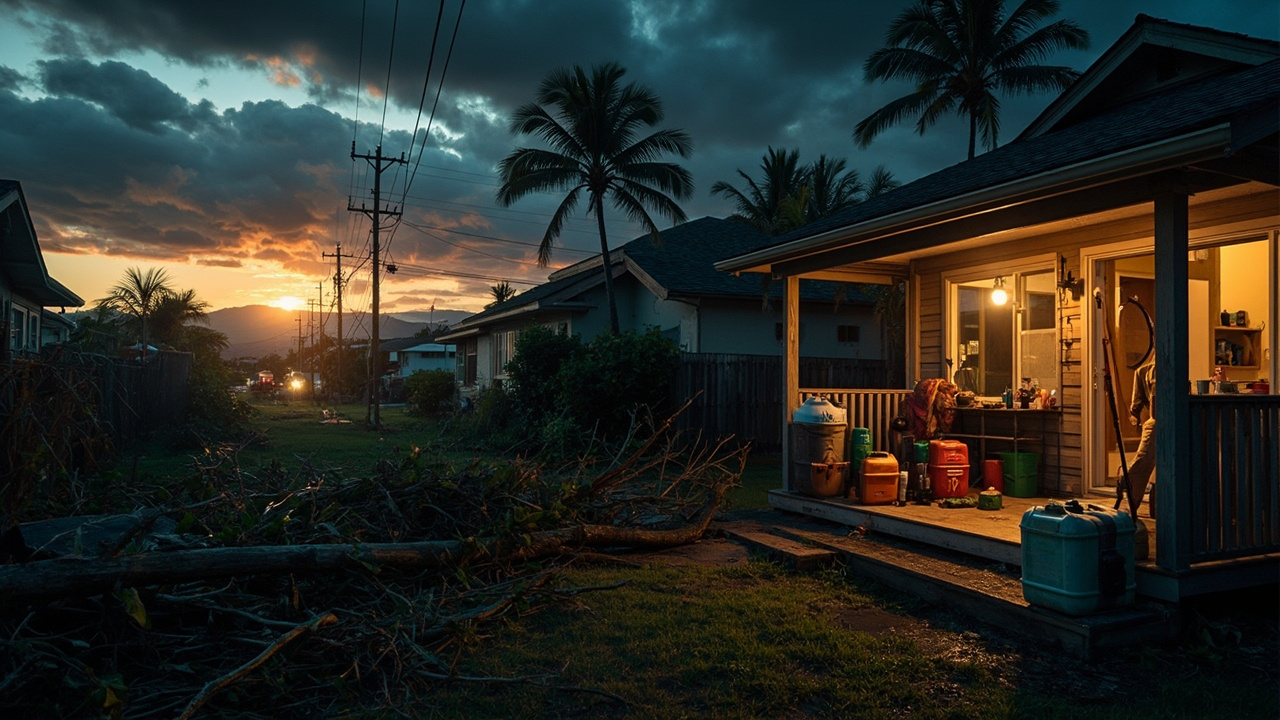
TL;DR: Hawaii households should plan for extended overnight power outages and possible water service interruptions on Aug. 15, 2026, as Tropical Storm Lala moves westward across the island chain.
Storm position on Aug. 15 demands overnight outage planning
Hundreds of Hawaiian Electric employees, contractors and support personnel have been working around the clock to address power outages on Hawaii Island, in Maui County and on Oahu, according to the 4 p.m. update: Hawaiian Electric fully mobilized for power restoration.
The company strongly urges customers to plan for possible extended outages, potentially overnight, as the storm system makes its way westward across the island chain at least through tomorrow, according to the same 4 p.m. update.
With wind gusts recorded at upwards of 60 mph in parts of Hawaii Island and West Maui, Hawaiian Electric urges customers to continue to plan for possible extended outages, potentially overnight, as the storm system makes its way westward across the island chain, according to the 12 p.m. update: Hawaiian Electric urges customers to prepare for potential extended outages.
Trees and debris blown into power lines are the primary causes of current outages, according to that 12 p.m. update.
County of Kaua'i officials are urging the public to be vigilant due to severe weather conditions as Kaua'i is expected to experience increasing impacts from Tropical Storm Lala, according to the 8:50 a.m., Aug. 15, County of Kaua'i, Tropical Storm Update.
According to the National Weather Service information cited in that county update, Tropical Storm Lala is expected to bring increasing impacts to Kaua'i beginning this evening and continuing through Sunday, with strong and gusty winds, periods of heavy rainfall, and large, rough surf.
Residents should remain alert for changing conditions and continue to monitor the latest forecasts and advisories, as impacts can occur well away from the storm's center, according to that county update.
Power outages by island at 11 a.m. and 3 p.m.
Approximately 23,900 customers are without power as of 11 a.m., with 22,270 restored ahead of severe storm rainbands, according to the 12 p.m. update: Hawaiian Electric urges customers to prepare for potential extended outages.
As of 11 a.m., Hawaii Island had about 18,700 customers without power in North and South Hilo, North and South Kohala, Hamakua and Puna, according to that 12 p.m. update.
On the Hamakua coast, crews are assessing a 42-mile span of transmission lines after fallen trees knocked down multiple poles and structures, according to that 12 p.m. update.
As of 11 a.m., Maui County had approximately 5,180 customers without power in the Upcountry areas of Makawao, Pukalani and Kula, as well as a part of Haiku and Puukolii in West Maui, according to that 12 p.m. update.
As of 11 a.m., Oahu had roughly 150 customers without electricity, with nearly 1,300 restored since the onset of the storm, according to that 12 p.m. update.
Approximately 44,000 customers are without power as of 3 p.m., according to the 4 p.m. update: Hawaiian Electric fully mobilized for power restoration.
As of 3 p.m., Hawaii Island had about 32,300 customers without power in Hilo, Kona, Kohala, Hamakua, and Puna, according to that 4 p.m. update.
On the Hamakua coast, wind-toppled trees knocked down multiple poles and structures along a 42-mile span of transmission lines, according to that 4 p.m. update.
Wind gusts upward of 70 mph have been recorded in parts of Hawaii Island, according to that 4 p.m. update.
As of 3 p.m., Maui County had approximately 3,300 customers without power in parts of Upcountry Maui, Haiku, as well as pockets in West and South Maui and Molokai, according to that 4 p.m. update.
Extreme wind gusts, often upward of 70 mph, have been battering West Maui since around noon, according to that 4 p.m. update.
In Upcountry Maui, crews had to pause work when trees fell in certain areas, according to that 4 p.m. update.
As of 3 p.m., Oahu had roughly 8,400 customers without electricity in Aina Haina, Kaimuki, Kalihi, Mapunapuna, Manoa and Nuuanu, according to that 4 p.m. update.
More than 42,000 customers across Hawaiian Electric's service territory have had power restored today, according to that 4 p.m. update.
Crews have been making steady progress, restoring electricity to 20,240 customers on Hawaii Island and 730 in Maui County who were affected by the powerful winds and pounding rain overnight and this morning, according to the 12 p.m. update.
Because of the dynamic nature of the storm system, outage numbers represent a snapshot in time and are subject to change as additional customers are restored and more outages occur, sometimes in the same area, according to both Hawaiian Electric updates.
Hawaii Island generation risk and possible load shedding
With four of its independent power providers disconnected from the electrical grid on Hawaii Island due to damage from the ongoing storm, Hawaiian Electric may need to "load shed," according to the 4 p.m. update: Hawaiian Electric fully mobilized for power restoration.
This means the company may temporarily turn off power to customers to maintain system stability and prevent damage to generating units, according to that 4 p.m. update.
The temporary forced outages would only affect Hawaiian Electric customers on Hawaii Island, according to that 4 p.m. update.
This is not part of the company's Public Safety Power Shutoff program, according to that 4 p.m. update.
Two of Hawaii Island's largest independent power producers, Puna Geothermal Venture and Hamakua Energy Partners, as well as wind energy providers Hawi Renewable Development and Pakini Nui, are also unable to connect to the island's grid, according to that 4 p.m. update.
Hawaii Island power generation is at risk due to storm and load shedding may occur, according to that 4 p.m. update headline summary.
Restoration work may need to pause as weather conditions intensify and make it unsafe for crew members and customers in the area, according to the 12 p.m. update.
Restoration work often needs to pause as weather conditions intensify and make it unsafe for crew members and customers in the area, according to the 4 p.m. update.
How Hawaiian Electric restores power and shares updates
Hawaiian Electric is working to keep outage maps and social media updated with information as it becomes available, according to the 12 p.m. update: Hawaiian Electric urges customers to prepare for potential extended outages.
Our priorities for restoration emphasize safety and essential community services, according to that 12 p.m. update.
Restoration also will take place in a manner designed to affect the greatest number of customers first, according to that 12 p.m. update.
Safety of public and work crews remain top priority, according to the 4 p.m. update headline summary.
Customers can track current outages and report outages using Hawaiian Electric's outage map at hawaiianelectric.com and on our mobile app, according to the 12 p.m. update.
Customers can call Trouble Lines to report any downed power lines, which should always be treated as energized and dangerous, according to both Hawaiian Electric updates.
The listed Trouble Lines are Hawaii Island at 1-855-304-9191, Maui County at 1-855-304-8181, and Oahu at 1-855-304-1212, according to both Hawaiian Electric updates.
Hawaiian Electric communicates restoration information to customers frequently through the news media and mobile-friendly resources, according to both Hawaiian Electric updates.
Those resources include the Hawaiian Electric website at hawaiianelectric.com, Twitter/X accounts @HwnElectric, @mauielectric and @hielectriclight, Facebook at facebook.com/HawaiianElectric, and a free mobile app download available on Apple App and Google Play stores, according to both Hawaiian Electric updates.
Customers are reminded to avoid downed power lines, according to the 12 p.m. update headline summary.
Kauai warnings, watches and county preparations
A Tropical Storm Warning remains in effect for Kaua'i and surrounding waters, while a Flood Watch is in effect from this evening through early Monday morning due to the potential for heavy rain, flash flooding, and rapidly rising streams, particularly in windward and mountainous areas, according to the 8:50 a.m., Aug. 15, County of Kaua'i, Tropical Storm Update.
A High Surf Advisory is also in effect for east-facing shores of Kaua'i, where surf is expected to build significantly as Lala moves westward, according to that county update.
The National Weather Service has issued a Tropical Storm Warning that will remain in effect until further notice, according to that county update.
The National Weather Service has issued a High Surf Advisory for east-facing shores that will remain in effect through 6 a.m. Sunday, August 15, according to that county update.
The National Weather Service has issued a Flood Watch that will remain in effect through 6 a.m. Monday, August 17, according to that county update.
There are no road closures at this time, according to that county update.
Officials note that Kuhio Highway near the Hanalei Bridge may be closed with little or no advance notice, particularly if a Flash Flood Warning is issued, according to that county update.
Utilities and other services may also be disrupted, according to that county update.
Department of Public Works crews at the County's district baseyards have conducted storm preparations, including clearing ditches, cleaning drains, and checking and fueling equipment, according to that county update.
Crews have pre-staged equipment in flood-prone areas so they can respond quickly if flooding or other storm impacts occur, according to that county update.
County crews have prepared signs, cones, barricades, and electronic message boards for deployment during road closures, traffic control, and public alerts as conditions change, according to that county update.
The Department of Land and Natural Resources has closed the Kalalau Trail, the Napali Coast State Park, and Polihale State Park, according to that county update.
The Ha'ena Shuttle has also been suspended, according to that county update.
County services and facilities may close on little to no notice, depending on the severity of the incoming storm and its effects, according to that county update.
What Kauai households should do before and during the storm
County officials encourage the public to check and replenish their emergency disaster kits, according to the 8:50 a.m., Aug. 15, County of Kaua'i, Tropical Storm Update.
Emergency disaster kits should include at least a 14-day supply of non-perishable food, one gallon of water per person per day, a battery-powered radio, a flashlight, an extra supply of prescription medicines, and other items tailored to individual and family needs, according to that county update.
A smaller, portable go-kit is also recommended should you need to evacuate, according to that county update.
"We are closely monitoring Tropical Storm Lala and preparing for the possibility of impacts across Kaua'i this weekend," said Mayor Derek S.K. Kawakami in that county update.
"Our County teams and emergency response partners are taking steps now to be ready, but we also need our community to do its part by securing property, checking emergency supplies, staying informed, and avoiding unnecessary travel and outdoor activities as conditions deteriorate," Mayor Kawakami said in that county update.
Do not go hiking or participate in outdoor and ocean recreational activities such as hiking, camping, swimming, surfing, and more, according to that county update.
Outdoor recreation areas may quickly become hazardous, according to that county update.
During severe weather, emergency rescues may not be possible, according to that county update.
Do not cross swollen rivers or streams; always check with a lifeguard at any lifeguard station before entering the ocean, according to that county update.
Water service: storage, conservation and Do Not Drink rules
The Department of Water reminds its customers to prepare for possible water service impacts during severe weather, according to DOW severe weather preparedness and awareness from the Kaua'i Department of Water.
Natural disasters, such as high winds, flooding, and fallen trees, can damage water infrastructure or disrupt power to water sources, leading to water service interruptions, according to that water department guidance.
While DOW crews are prepared to respond, restoration efforts can only begin when conditions are safe, according to that water department guidance.
If dangerous conditions prevent crews from accessing affected areas, outages may last longer than usual, according to that water department guidance.
Once conditions improve and it is safe to do so, crews will assess and make the repairs, according to that water department guidance.
Customers should store the recommended amount of water, minimum recommendation of 1 gallon per person per day, in their emergency kits to meet their needs until service can be restored, according to that water department guidance.
Visit www.kauai.gov/KEMA for an emergency kit check list, according to that water department guidance.
To store water properly, use clean containers, preferably those designed for water storage such as FDA-approved food-grade water storage containers, according to that water department guidance.
Do not use containers that may have previously stored hazardous or questionable materials, or food with strong odors, or are made of easily breakable materials such as glass, according to that water department guidance.
Fill the container with tap water, leaving minimal air space between the water and the cap, according to that water department guidance.
Store it in a cool, dark place, according to that water department guidance.
For more information or questions about boiling or disinfection, please call DOW's Water Quality Division at 245-5457, according to that water department guidance.
A water conservation request is typically issued to prevent a water storage tank from draining during a power outage, according to that water department guidance.
During a water conservation request, customers are advised to limit water use to essential needs only, such as drinking, cooking, and personal hygiene, according to that water department guidance.
In addition, customers should turn off plumbing fixtures that automatically draw water, including irrigation and ice machines, for the duration of the conservation notice, according to that water department guidance.
A Do Not Drink advisory is issued only if the quality of the water may be compromised, according to that water department guidance.
During a Do Not Drink advisory, customers are advised not to consume tap water until further notice, according to that water department guidance.
This includes drinking, making ice, brushing teeth, washing dishes, and preparing food, according to that water department guidance.
Tap water should not be consumed until DOW has officially announced it is safe, according to that water department guidance.
Stay tuned to local radio stations and news reports, according to that water department guidance for what to do in a storm.
Immediately begin water conservation measures, using water sparingly, according to that water department guidance for what to do in a storm.
Water should be used for essentials: cooking, drinking, and sanitation, according to that water department guidance.
Keep toilet flushing to a minimum, according to that water department guidance.
Collect rainwater to utilize for non-potable water needs, according to that water department guidance.
Do not drink rainwater, according to that water department guidance.
Turn off or disconnect any devices or fixtures that regularly draw water such as automatic ice machines and irrigation systems, according to that water department guidance for what to do in a storm.
After the storm has passed, DOW will assess its water infrastructures, according to that water department guidance for what to do after a storm.
If water lines are damaged, or conservation notices have been issued, please continue to conserve water until DOW officially announces that the conservation has been lifted, according to that water department guidance.
Any water service interruption updates will be posted at www.kauaiwater.org, social media platforms, and relayed to local radio stations, as needed, according to that water department guidance.
Receive DOW Alerts by signing up for Everbridge, the County of Kaua'i's mass notification system, for water service notifications such as water service outage alerts, water conservation notices, Do Not Drink notifications, and other water related emergency alerts, when possible, according to that water department guidance.
To sign up, visit www.kauai.gov/KEMA, according to that water department guidance.
For DOW updates, visit www.kauaiwater.org, according to that water department guidance.
Refuge areas and last-resort sheltering on Kauai
No refuge areas are open at this time, according to the 8:50 a.m., Aug. 15, County of Kaua'i, Tropical Storm Update.
However, refuge areas islandwide are on standby, should the need arise, according to that county update.
The public is reminded that refuge areas are evacuation options of last resort, according to that county update.
In many cases, sheltering in place may be a good option, particularly if the home or structure is sound or hardened and located outside hazardous flood and storm-surge areas, according to that county update.
Refuge areas do not provide food, water, bedding, medications, personal caregivers, or medical staff, and anyone going to a refuge area should bring their own disaster supply "go kit," according to that county update.
Household pets are welcome at all designated facilities, though owners must bring their own pet food, water, and crates or cages, according to that county update.
KEMA released an updated Potential Refuge Area List in May, available online at www.kauai.gov/KEMA, which identifies facilities that may be considered for use during emergencies, according to that county update.
Not every facility on the list will be opened during every emergency, and additional public or private facilities may also be activated depending on incident and operational needs, according to that county update.
If refuge areas are activated for this event, KEMA will issue news releases, update the County website and its Refuge Area Status Page, and, as appropriate, send notifications through the County's Everbridge emergency notification system, according to that county update.