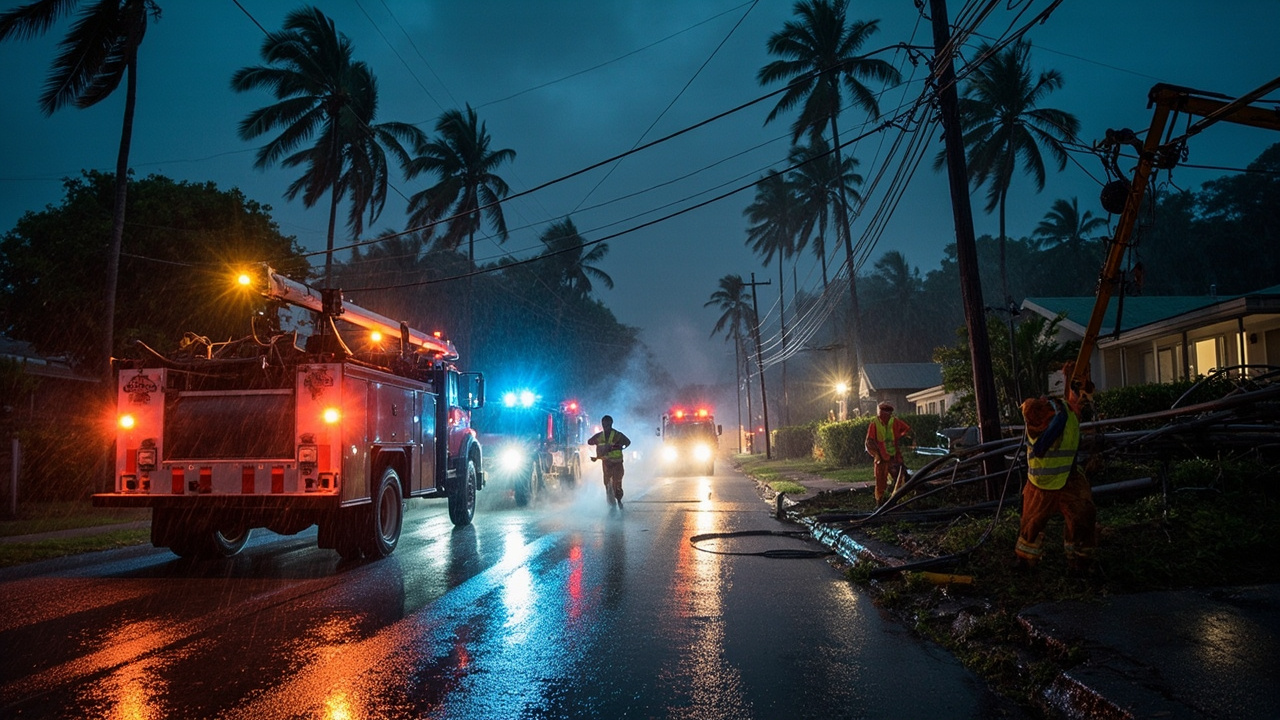
TL;DR: Hawaiian Electric said about 44,000 customers were without power at 3 p.m. as Tropical Storm Lala moved west, with crews working across three counties and residents urged to prepare for outages that could last overnight.
Hawaiian Electric reported hundreds of employees, contractors and support staff were assigned around the clock on Aug. 14 to storm-related outages on Hawaii Island, in Maui County and on Oahu, according to the company's 4 p.m. update: Hawaiian Electric fully mobilized for power restoration. The utility said customers should plan for possible extended outages, potentially overnight, as the weather system continued westward across the island chain at least through the next day.
That warning matters for household planning tonight: outage totals were changing as new interruptions occurred while other customers were restored, and field work could pause when conditions became unsafe. More than 42,000 customers had regained service during the day, but the 3 p.m. snapshot still showed roughly 44,000 without electricity.
How large were outages at 3 p.m.?
The 3 p.m. snapshot cited in the 4 p.m. update listed about 32,300 customers without power on Hawaii Island, approximately 3,300 in Maui County and roughly 8,400 on Oahu, for a territory-wide total near 44,000.
On Hawaii Island, affected areas included Hilo, Kona, Kohala, Hamakua and Puna. In Maui County, outages affected parts of Upcountry Maui and Haiku, as well as pockets in West and South Maui and on Molokai. On Oahu, neighborhoods listed included Aina Haina, Kaimuki, Kalihi, Mapunapuna, Manoa and Nuuanu.
The company emphasized that outage figures represent a moment in time. As crews restored one area, wind and falling vegetation could cause a new outage nearby, sometimes in the same neighborhood. For households, the practical point is to treat a restoration at one address as no guarantee that power will remain stable while the storm is still passing.
Residents who rely on electrically powered equipment should therefore keep backup arrangements in place even after lights return, and keep phones, radios and battery packs charged while power is available.
Why Hawaii Island faced added generation risk
The update said power generation on Hawaii Island was at risk because four independent power providers were disconnected from the grid due to storm damage.
Those providers were identified as Puna Geothermal Venture and Hamakua Energy Partners, described as two of the island's largest independent producers, plus wind providers Hawi Renewable Development and Pakini Nui. With those resources unable to connect, the island had less available generation to meet demand and maintain stable frequency.
To protect the remaining system, Hawaiian Electric said it may need to use load shedding on Hawaii Island. In plain terms, that means temporarily turning off power to some customers to preserve system stability and avoid damage to generating units. The company said any temporary forced outages for this reason would affect only its Hawaii Island customers.
The utility specifically distinguished load shedding from its Public Safety Power Shutoff program. Load shedding described in the 4 p.m. update would be an operational stability action, not a proactive wildfire-prevention shutoff. That distinction is important because earlier in the day the company issued separate wildfire-risk messages, including Hawaiian Electric monitoring wildfire risk conditions on Hawaii Island, before later ending a shutoff watch when fire-weather conditions eased.
What wind and trees did to lines and poles
Wind was a central cause of damage described in the update. Gusts upward of 70 mph were recorded in parts of Hawaii Island, while extreme gusts often above 70 mph had battered West Maui since around noon.
On the Hamakua coast of Hawaii Island, wind-toppled trees brought down multiple poles and structures along a 42-mile stretch of transmission lines. Transmission damage is significant for restoration planning because those higher-voltage lines carry large amounts of power over long distances; repairs can require heavy equipment, cleared access and safer wind conditions before crews can climb or set new poles.
In Upcountry Maui, crews had to pause work in certain areas after trees fell. On Oahu and in other counties, restoration was also subject to pauses as weather intensified. Hawaiian Electric said crews were restoring electricity as quickly and safely as possible, but work often must stop when high winds, flooding, lightning, fallen trees or debris create hazards for workers and nearby residents.
An earlier preparedness release, Hawaiian Electric ready to respond to impacts from Tropical Storm Lala, said restoration would begin only when conditions were safe. That release, dated Aug. 14, said more than 500 employees, contractors and support workers were positioned statewide for assessment and restoration, with coordination underway with federal, state and county emergency management agencies.
Who was mobilized and how restoration proceeds
The 4 p.m. update described hundreds of utility employees, contractors and support personnel working around the clock on assessment, repairs and restoration across Hawaii Island, Maui County and Oahu.
Earlier Aug. 14 planning actions included activating the incident response plan, conducting additional tree trimming and vegetation management near key transmission lines and critical infrastructure, positioning crews across service territories, inspecting and staging equipment, materials and vehicles, and reviewing operational plans for generating facilities and critical systems.
The later messages said staffing had been increased to round-the-clock coverage on Hawaii Island, with additional personnel arriving from Oahu before the storm. Crews were described as ready in Hilo, Kona and Waimea, with the option to move more crews between islands as needed. Contractors were standing by to assist once it became safe after passage of the storm, and the company reported a stocked inventory of poles, transformers and other key equipment already on Hawaii Island.
Households should expect a phased process: damage patrols and hazard clearing, then repairs to larger lines, then smaller distribution lines and individual service connections. Road closures from flooding and debris can delay patrols, so a lack of visible repair trucks does not necessarily mean an outage has not been reported.
What households should do during extended outages
Hawaiian Electric urged customers to review emergency plans, keep needed supplies on hand and monitor weather updates closely. Detailed preparation information was posted at hawaiianelectric.com/stormcenter, along with a free Handbook for Emergency Preparedness available in several languages and a version for children.
For immediate household safety, the company's preparedness guidance advised checking flashlights, emergency generators, battery-operated, hand-crank or solar radios, light sticks and lanterns to confirm they work, and buying extra batteries. Families with a member dependent on electrically powered life-sustaining medical equipment were advised to check backup options, plan where to go if evacuation becomes necessary, and bring medical equipment and medications if moving to a hospital or emergency shelter.
If using a ladder to prepare a home, the utility advised noting power-line locations first and keeping people, ladders, scaffolds and tools at least 10 feet away from lines. It also advised turning off and unplugging a television before lowering an antenna or satellite dish.
For portable generators after the storm, the guidance was to place the unit in a well-ventilated area outside the home and follow all instructions in the manufacturer's manual. Other wildfire-risk guidance advised turning refrigerators and freezers to coldest settings before a potential outage, turning off and unplugging unnecessary equipment and sensitive electronics to reduce surge damage, avoiding travel in the dark near possible downed lines, and avoiding standing water and debris.
Treat every downed line as energized and dangerous. Stay well away, warn others to stay away, and call 911 for an immediate hazard.
How to report hazards and follow official updates
Customers can report downed power lines to Hawaiian Electric Trouble Lines: Hawaii Island at 1-855-304-9191, Maui County at 1-855-304-8181, and Oahu at 1-855-304-1212. The company also pointed customers to hawaiianelectric.com, its X accounts @HwnElectric, @mauielectric and @hielectriclight, its Facebook page, and its free mobile app on Apple and Google Play stores.
Because outage numbers shift during an active storm, households should rely on those official utility channels and weather alerts rather than social rumors. Keep a battery-powered or hand-crank radio available in case mobile service or home internet fails, and check periodically for revised restoration information once winds ease enough for crews to work continuously.
Sources referenced
- 4 p.m. update: Hawaiian Electric fully mobilized for power restoration | Hawaiian Electric (https://www.hawaiianelectric.com/4-pm-update-hawaiian-electric-fully-mobilized-for-power-restoration)
- Hawaiian Electric ready to respond to impacts from Tropical Storm Lala | Hawaiian Electric (https://www.hawaiianelectric.com/hawaiian-electric-ready-to-respond-to-impacts-from-tropical-storm-lala)