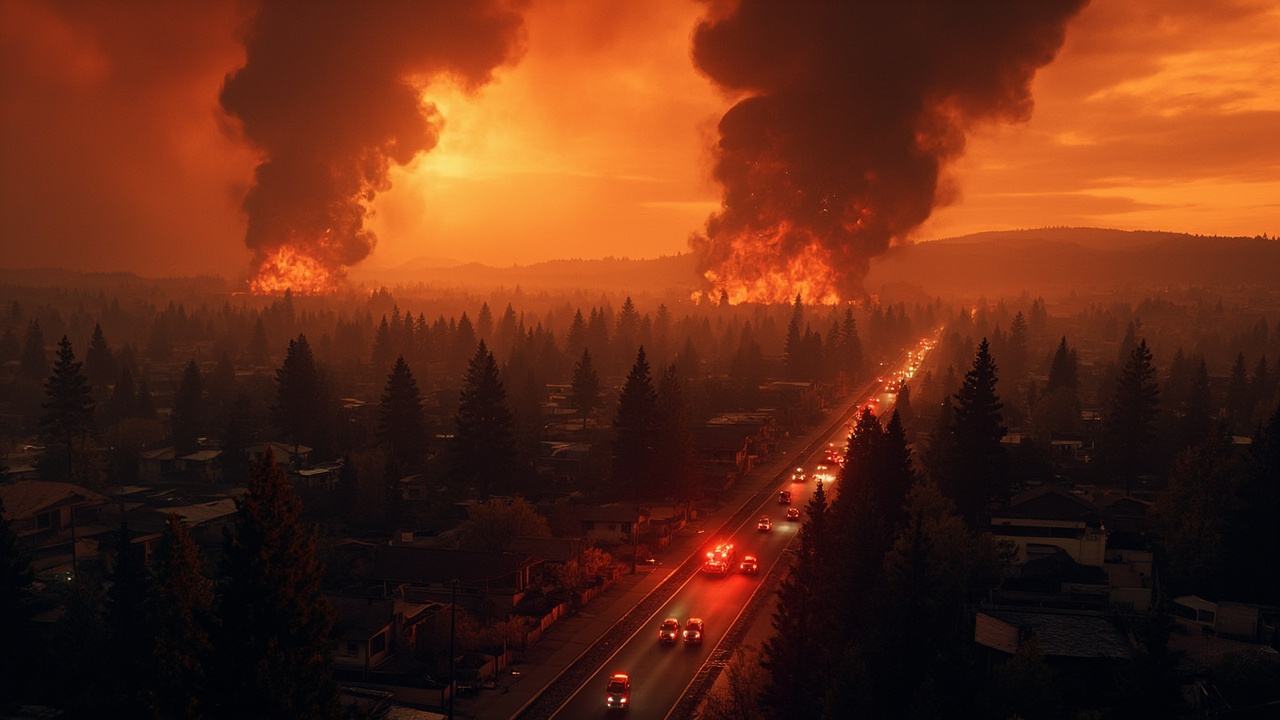
TL;DR: On Aug. 9, 2026, firefighters were working to contain 94 of 183 reported wildfires across the United States amid hot, dry weather and stretched national resources.
More than 20,000 people in southwest Canada and the western United States had fled their homes as wildfires fueled by hot, dry weather burned more than 3 million acres, according to USA Today.
As of Aug. 9, the National Interagency Fire Center reported 183 wildfires burning across the United States, including eight large new ones, according to USA Today. Firefighters were working to contain 94 of those blazes.
More than 30,000 personnel were assigned to large fires across the country as officials shifted crews and equipment to the most dangerous locations, according to NBC News. The national system was moving resources daily among competing incidents while facing heavy demand and the threat of additional starts.
National fire count on Aug. 9
The Aug. 9 national picture centered on 94 large fires receiving full suppression assignments. NBC News reported that more than 30,000 personnel were battling 94 large fires across the country on that date.
USA Today reported the broader total of 183 wildfires burning nationally on Aug. 9. Eight of those were described as large new fires.
A day earlier, the balance was similar but slightly higher for large incidents. As of Aug. 8, 2026, crews were working to contain 97 large fires across the country, according to CBS2 reporting in Idaho. That report counted 83 new fires nationwide since the previous day, including nine new large fires.
The scale of assigned resources was documented in the same Aug. 8 report. A total of 30,636 personnel were assigned to incidents nationwide, including 661 crews, 1,856 engines and 204 helicopters.
In addition, 26 complex incident management teams and one national incident management organization were committed nationally, according to that CBS2 report.
Where large fires were concentrated
Oregon and Washington carried the largest state counts of large fires in the national roundup. ABC News reported nearly 100 large, uncontained wildfires nationally, including 26 fires in Oregon and 19 in Washington state.
Oregon also had four fires forcing evacuations on Aug. 9, including the Wrights Spring Fire and three others across the state, according to USA Today.
In Washington, attention remained on Spokane-area fires that began Aug. 1. The Spokane-area fires included the Old Trails, Autumn Lane and Fairview fires, according to reporting summarized by the Idaho Capital Sun via the Spokesman-Review.
As of Friday morning, Aug. 7, the Spokane Complex fires had burned an estimated 10,363 acres in Spokane and Stevens counties in Washington, with containment estimated at 23% for the Old Trails fire, according to that report.
The same report said the Spokane-area fires had damaged or destroyed an estimated 846 structures, according to the California Interagency Incident Management Team 7 and the Washington Department of Natural Resources daily briefing issued Friday morning.
Idaho state officials said Idaho had sent two strike teams of engines to North Idaho, as well as a team of Idaho Department of Lands engines to support wildfire efforts in Spokane, according to the Spokesman-Review report.
As of Thursday, Aug. 6, more than 1,500 personnel from 20 states and 100 different jurisdictions were helping fight the Spokane Complex fires, officials said in that report.
Oregon's Wrights Spring Fire
The Wrights Spring Fire in southern Oregon had burned more than 30,000 acres since it started Aug. 5, according to USA Today. As of Aug. 9, the fire remained uncontained.
The fire claimed the life of a first responder. Jason Ensign, 47, from Klamath Falls, Oregon, was operating a bulldozer to improve access to the fire when it unexpectedly grew, according to USA Today. Rescue crews later found him dead.
The CBS2 report placed the fatal injury on Aug. 6. On Aug. 6, a dozer operator was fatally injured while engaged in firefighting operations on the Wrights Spring fire outside Chiloquin, Oregon, according to that report.
The Wrights Spring Fire was one of four fires across Oregon that forced evacuations, according to USA Today.
Utah helicopter accident
The wildland fire community reported three fatalities in the field over two days, according to the Aug. 8 CBS2 report.
One of those events involved the Wrights Spring fire on Aug. 6. The other involved an aircraft accident on Aug. 7.
On Aug. 7, a helicopter on contract with the U.S. Forest Service was involved in an accident on the Widemouth 2 Fire outside Kanosh, Utah, according to the CBS2 report. The pilot and one crewmember were fatally injured.
Forest Service Chief Tom Schultz said four wildland firefighters had already died in the line of duty this year, according to the Spokesman-Review report from an Aug. 7 news conference.
California's Bug Fire
Among the newer California incidents was the Bug Fire, which began Saturday in California, according to ABC News. The fast-moving blaze had burned over 4,100 acres and had prompted evacuations near Reno, Nevada.
The Bug Fire started on the same weekend that national managers reported eight large new fires nationally as of Aug. 9, according to USA Today.
California's broader incident count remained high even where acreage was lower than in the Northwest. The separate conditions on Aug. 9 included dangerous heat and very dry air across lower elevations, with poor overnight recovery in some areas.
For households near Reno and in Lassen County areas affected by smoke and evacuation notices, the practical step stated in federal guidance was to follow local evacuation orders and check current incident postings. Air quality information related to specific fires is available on InciWeb at https://inciweb.wildfire.gov/, according to the CBS2 report.
Heat, wind and humidity on Aug. 8-9
Dangerous heat affected both eastern and western states during the weekend, according to ABC News. In the Northeast, extreme humidity sent the heat index soaring to 95 degrees in New York City and 101 degrees in Washington, D.C., on Saturday.
At the Jersey Shore, the heat index hit 109 degrees on Friday, according to ABC News. A heat advisory was in effect through Saturday evening from Connecticut to Maryland, where temperatures could feel like 98 to 100 degrees.
High temperatures were expected to continue into Monday, when it was forecast to feel like 98 degrees in New York City and 100 in D.C., according to ABC News.
In the West, record temperatures were possible from Texas to California. On Sunday, potential record highs included 100 degrees in Denver, 99 degrees in Albuquerque, New Mexico, and 107 degrees in Madera, California, according to ABC News.
Wind and dry air increased spread risk. ABC News reported wind gusts up to 35 mph and humidity as low as 5%, creating dangerous conditions for fires to spread Saturday evening.
The fires were also bringing poor air quality to much of the western half of the U.S., according to ABC News.
National preparedness level and resource strain
The country remained at the highest national preparedness level during this period. The nation had stayed at Level 5 of national preparedness since July 18 in the Spanish-language version of the NBC News report, reflecting significant activity and heavy demand for suppression resources.
Incident commander Tom Clemo of California Interagency Incident Management Team 7 told NBC News that centers across the country distribute resources according to priorities. Those priorities are reviewed daily and reorganized each night so the most serious incident receives needed critical resources in time, according to the translated account of his remarks.
Asked whether the system could handle another large fire and when resources would run short, Clemo said pressure was already being felt, according to that report. He said it was already happening in several incidents growing in complexity, size and destructive capacity.
As conditions improved in Spokane, authorities were beginning to release some crews and personnel back into the national system, with more potentially available by midweek if weather cooperated, according to that NBC News account.
Idaho Gov. Brad Little and U.S. Forest Service Chief Tom Schultz said Friday, Aug. 7, that firefighting resources were stretched thin as significant wildfires burned across Washington, Oregon, Idaho and much of the West, according to the Spokesman-Review.
Little said hot temperatures, dry fuels, low humidity and changing winds were creating conditions where wildfires could spread rapidly and unpredictably, according to that report. He said those conditions were placing heavy demands on firefighters and firefighting resources throughout the region and country.
What households should monitor
Federal fire information points remained the stated sources for current perimeters, smoke outlooks and health recommendations. The AirNow Fire and Smoke Map provides hourly updates, outlooks and health recommendations at https://fire.airnow.gov/, according to the CBS2 report.
Air quality information related to specific fires is also available on InciWeb at https://inciweb.wildfire.gov/, according to the same report.
Residents in fire-prone areas were described as familiar with monitoring tools and the three levels of evacuation — Ready, Set, Go — according to The Atlantic. People tracked fire progress on phones and calculated how much time they might need to reach safety.
For household planning, the actionable federal reference was to monitor evacuation orders, have go-bags ready, and check InciWeb and the AirNow Fire and Smoke Map for incident and smoke information. Those sources were listed in national fire-center summaries carried in the Aug. 8-9 reports.
Prevention was presented as direct help for stretched crews. Little said preventing the next wildfire may be the single greatest way people can help support firefighters already working nonstop, according to the Spokesman-Review.
How to reduce human-caused starts
State and federal officials asked the public to redouble prevention efforts as hot, dry weather continued, according to the Spokesman-Review.
Little urged residents to follow fire restrictions in their area and avoid activities that create sparks, according to that report. He listed campfires, trailers, dragging chains, outdoor equipment and fireworks as items requiring caution around dry grass or brush.
He also urged residents to make sure campfires are completely extinguished, according to that report. He said one careless moment can change lives.
As of Friday, Aug. 7, most of Idaho was under fire restrictions, which prohibit campfires outside approved U.S. Forest Service metal fire rings, including prohibiting campfires at dispersed and undeveloped campsites, according to that report.
Schultz said there had been more than 1,000 fires in Washington and more than 600 in Idaho so far this year, according to that report. He said the number of fires and acres burned across the country was above the 10-year average.
Officials suspected the Old Trails fire was started by arson, according to that report. Local police arrested 37-year-old Aaron Farinacci on suspicion of first-degree arson, and Farinacci confessed to detectives to having planned and set the Old Trails fire, according to reporting by Alexandra Duggan of The Spokesman-Review cited in the same account.