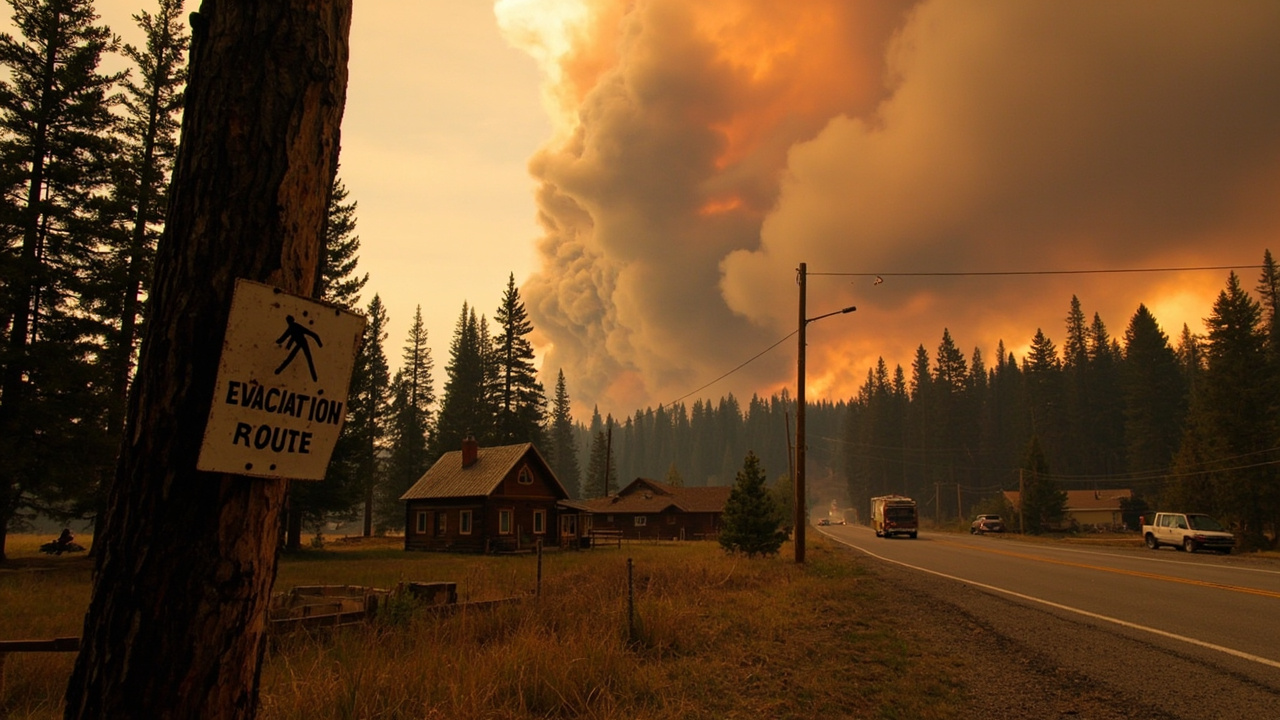
TL;DR: More than 11,000 residents across Oregon, Washington, and Idaho were under wildfire evacuation orders or warnings on August 17, 2026, with Level 3 GO orders still active in multiple counties.
Three States Under Evacuation Orders
Evacuation orders and warnings linked to active wildfires were affecting communities in Oregon, Washington, and Idaho during the week of August 17, 2026, according to NW FireWatch in "Evacuation Orders Span Three States as Wildfires Force More Than 11,000 From Their Homes."
Estimates placed the total number of displaced residents at more than 11,000 across the three states. Fire officials and emergency managers urged anyone under an evacuation order to leave immediately and not wait for conditions to worsen.
The same reporting network, in "2026 Fire Season By the Numbers: Pacific Northwest on Pace for Most Destructive Year on Record," stated that as of August 16, 2026, the 2026 season had burned 7.2 million acres across the United States. That total was nearly double the acreage burned by the same date in 2025, when 3.76 million acres had burned.
Oregon, Washington, and Idaho together hosted 46 of the nation's 87 uncontained large fires, that second NW FireWatch assessment reported. The concentration of uncontained fires placed the Pacific Northwest at the center of national fire activity on August 16.
Washington: Spokane Complex and North-Central Fires
Washington had seen the most intense evacuation activity of the season by August 17, according to "Evacuation Orders Span Three States as Wildfires Force More Than 11,000 From Their Homes."
The Spokane Complex fires erupted on August 1 under a historic Particularly Dangerous Situation Red Flag Warning. The fires burned through more than 7,700 acres and destroyed or damaged more than 600 structures in and around Spokane. Level 3 GO evacuation orders remained in effect for areas within active fire perimeters.
Communities identified as subject to evacuation orders or warnings during the season included Lake Chelan, Tonasket, Inchelium, Mead, and portions of the Spokane area. The listing reflects orders or warnings issued at different points during the fire season, not a single-day evacuation map.
The Sinlahekin Fire near Tonasket had evacuation orders and area closures in effect as it continued threatening residences and critical infrastructure. Residents near that incident were directed to follow closure boundaries in addition to evacuation notices.
The Kaiser Canyon Fire forced the evacuation of the entire population of Nespelem on the Colville Reservation after the fire expanded rapidly following its July 16 ignition. Containment had improved substantially by August 17, but affected tribal members were advised to continue monitoring guidance from the Colville Business Council and Okanogan County Emergency Management.
Statewide totals underscore the severity in Washington. According to "2026 Fire Season By the Numbers: Pacific Northwest on Pace for Most Destructive Year on Record," more than 425,000 acres had burned across the state, with at least 2 deaths, 11,000 people evacuated, and more than 600 structures destroyed or damaged.
Washington also set multiple records during the season. The state received its first-ever Particularly Dangerous Situation Red Flag Warning, declared its first-ever statewide public health emergency due to wildfire smoke, and recorded air quality readings in Leavenworth that exceeded the traditional index maximum of 500 by more than 70 percent.
Oregon: Josephine County Evacuations and Big Grass Fire
Southern Oregon saw urgent evacuations during the week of August 17 as the Fielder Mountain Fire grew rapidly overnight near the rural community of Rogue River, between Grants Pass and Medford.
Approximately 1,000 people were ordered to evacuate their homes in Josephine County because of that growth. The Oregon Department of Forestry Southwest District was managing the incident. In the same region, ODF Team 3 assumed command of the Rosenbaum Fire.
In southeastern Oregon, the Big Grass Fire had Level 3 GO evacuation orders in effect in portions of Malheur County near Jordan Valley since late July. Ranches, rural residences, and outlying communities were threatened as the fire grew beyond 513,000 acres.
Residents in those Malheur County areas were advised to have livestock evacuation plans in place in addition to personal evacuation preparations. The guidance reflects the ranching landscape around Jordan Valley, where animals and equipment require earlier movement than household loading alone.
Oregon was battling its largest wildfire on record on August 16, the Big Grass Fire at over 513,000 acres, along with more than 30 other active fires, according to "2026 Fire Season By the Numbers: Pacific Northwest on Pace for Most Destructive Year on Record." The state's 24 large active fires represented the most of any state in the nation at that time.
Governor Kotek sought federal cost-sharing assistance for fire suppression, though the Trump administration denied two of five applications, that same assessment reported.
Idaho: Washington County Orders and Public-Lands Closures
The Big Grass Fire's spread into southwestern Idaho triggered evacuation orders in Washington County, Idaho, according to "Evacuation Orders Span Three States as Wildfires Force More Than 11,000 From Their Homes."
The Tartar Fire near Weiser was 98 percent contained at 158,027 acres, but access closures remained in effect on adjacent public lands. The continued closures meant evacuated or nearby households could not assume that containment allowed re-entry to trails, rangeland, or recreation sites.
Idaho had six large fires in the August 16 accounting, including the near-contained Tartar Fire and portions of the Big Grass Fire burning across the Oregon-Idaho border. Fire managers were also monitoring access impacts on public lands ahead of early hunting seasons, with closures in effect around both the Big Grass and Tartar fire areas.
Nationally, the year-to-date fire count through August 16 was 48,848 fires and 7,219,058 acres, compared with 43,832 fires and 3,757,847 acres in the same period of 2025. Earlier comparisons listed 30,293 fires and 5,476,421 acres in 2024, 35,382 fires and 1,679,776 acres in 2023, 42,489 fires and 5,930,293 acres in 2022, and 40,475 fires and 4,044,003 acres in 2021.
The assessment stated that while the number of fire starts was somewhat elevated above recent averages, the acreage burned was dramatically higher, indicating fires that grew much larger than typical before being contained.
Why the 2026 Season Escalated
Fire scientists pointed to a combination of factors that made 2026 especially severe in the Pacific Northwest, according to "2026 Fire Season By the Numbers: Pacific Northwest on Pace for Most Destructive Year on Record."
Record-low winter snowpack was cited first. The Cascade snowpack, which normally provides a season-long source of soil moisture, was dramatically below average, leading to early drying of fuels across the region.
Washington's Department of Ecology declared a statewide drought emergency in April, months before the peak fire season, a sign of how far ahead of normal the drying had progressed. Multiple heat events then pushed temperatures well above average across the region throughout July and August, accelerating fuel drying.
Mid-July dry thunderstorm events ignited dozens of fires simultaneously, overwhelming initial attack resources across Washington and Oregon at the same time. That clustering helps explain why so many large fires remained uncontained into mid-August.
That assessment added that the peak fire weather window typically extends through September. Agencies, communities, and residents across the Pacific Northwest were described as needing to remain vigilant and prepared because the season was not yet over.
What Evacuation Levels Require
Oregon, Washington, and Idaho use a three-level evacuation system, detailed in "Evacuation Orders Span Three States as Wildfires Force More Than 11,000 From Their Homes."
Level 1 READY means be aware and prepared. A fire is in the area, and residents should monitor conditions and be ready to leave.
Level 2 SET means be packed and ready to leave immediately. Residents with special needs or livestock should consider leaving at this stage rather than waiting for an upgrade.
Level 3 GO means leave immediately. Residents should not delay or return to retrieve belongings because life is at risk.
Households under Level 2 should treat packing as a final step, not an early step. The guidance to move people with special needs and animals during SET is intended to avoid last-minute loading under Level 3 conditions.
Where Displaced Households Can Get Help
The Washington Department of Social and Health Services was providing emergency assistance for wildfire-displaced residents. Oregon's 2-1-1 information line was coordinating shelter and resource information for those evacuated by Oregon fires. Idaho Health and Welfare was similarly supporting displaced residents in affected counties.
Residents were urged to register with their county emergency management office if evacuating, both so officials can account for people and so recovery assistance can be coordinated once return is safe. Registration also supports follow-up contact if conditions change or additional documentation is needed for assistance.
Officials advised residents not to rely solely on social media for evacuation information. Households were urged to sign up for their county's emergency alert system for the most accurate and timely notifications.
That alert-system step matters when orders cover dispersed rural addresses around places such as Jordan Valley, Tonasket, Nespelem, and Rogue River. County alerts carry the specific Level 1, Level 2, or Level 3 designation for a defined zone, while forwarded posts may omit the zone or carry an older status.
Sources referenced
- Evacuation Orders Span Three States as Wildfires Force More Than 11,000 From Their Homes — NW FireWatch (https://www.nwfirewatch.com/article/evacuation-orders-span-three-states-as-wildfires-force-more-than-11000-from-their-homes)
- 2026 Fire Season By the Numbers: Pacific Northwest on Pace for Most Destructive Year on Record — NW FireWatch (https://www.nwfirewatch.com/article/2026-fire-season-by-the-numbers-pacific-northwest-on-pace-for-most-destructive-year-on-record)